



April 22, 2026 – The following information is from Sally Scalera who is an urban horticulture agent and master gardener coordinator for the University of Florida’s Institute of Food and Agriculture Science. Published in FLORIDA TODAY.
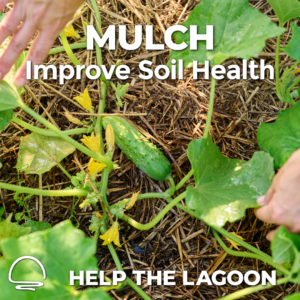 MULCH
MULCH
Following the nine principles of Florida-Friendly Landscaping is a great way to have a healthy landscape without harming the environment. Today’s topic is the fourth principle.
Adding mulch around plants will benefit plants and the soil in the following ways.
WHY MULCH?
- Prevent water loss from the soil due to evaporation.
- Provides weed control when it is applied three to four inches deep. A thick layer of mulch shades the soil, so many weed seeds on the surface won’t germinate.
- Moderates soil temperature. This is very important throughout most of the summer and during our winter cold fronts.
- An important reason for using mulch is that organic mulches improve sandy soils by adding organic matter as they break down. Organic matter improves soil structure, serves as a food source for soil microbes, and supplies plants with nutrients. Organic matter will also increase the soil’s water-holding capacity, which is helpful during a drought.
- For everyone growing vegetables, mulch is beneficial because it can prevent soil containing bacterial and/or fungal pathogens from splashing onto the undersides of leaves and initiating a disease.
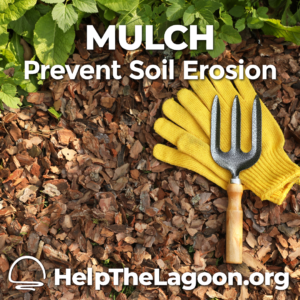
- Protects against soil erosion.
- Protects plant stems/trunks from mechanical damage. When a mulch ring is maintained with a minimum radius of 18 inches, mowers and weed-eaters will be prevented from hitting the plant.
 What kind of mulch do you need, and why?
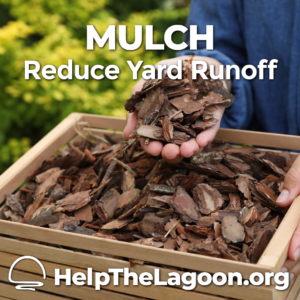
The following materials can be used as mulch: pine bark nuggets, wood chips, grass clippings, brown leaves, pine needles, and compost.
- Mini pine bark nuggets have a dark brown color that works well under trees, shrubs, perennials, and vegetable plants.
- Grass clippings are also good, but it is best to let them dry before spreading them around plants like vegetables and annuals. With grass clippings, earthworm activity will increase, which is beneficial!
- Brown leaves, such as oak, maple, sycamore, etc., are also good to use as a mulch. Oak leaves are fine to use whole, but they will take longer to break down. Pine needles, or pine straw, are also great to use either whole or chopped into smaller pieces. If you chop the brown leaves and pine needles up before applying them, they will break down faster. This will increase the soil’s organic matter more quickly but will require it to be reapplied more often.
- Cypress mulch is not recommended because it may not be a by-product of the forestry industry. Some companies harvest cypress trees from cypress domes and chip them into mulch.
- Eucalyptus mulch is harder to find, but it is a renewable mulch grown on plantations to produce mulch.
- Anyone with a compost pile can also use the humus (the result of composting) as mulch. Good-quality aerobic compost will be dark chocolate in color and have a pleasant, earthy smell. This will also stimulate earthworm activity, as does the use of grass clippings, brown leaves, and pine needles.
HOW TO MULCH
Mulching is simple; just keep the mulch three to four inches thick over the roots of plants. The exception to this rule is when it is placed around trees. In this case, only a thin layer of mulch should be applied close to the tree trunk, as a thick layer could promote the formation of girdling roots.
Never practice “volcano mulching” on trees where the mulch is piled high around the trunk. This can create a habitat for rodents, leading to bark chewing and possible vascular tissue damage, as well as the production of girdling roots.
This weekend is a good time to take a walk around your yard. Check your plants to see if they could use more mulch. If soil is visible or weeds are present, now is a great time to spread new mulch. Your plants will appreciate it!
What You Can Do Today:
Support the Brevard Indian River Lagoon Coalition.
Explore MEMBERSHIP and benefits. Or make a DONATION.
Be part of the solution.
Right now there are vital VOLUNTEER OPPORTUNITIES available.
SIGN UP today for talking to your neighbors, linking us to groups and organizations where we can speak, pointing us to events and other opportunities to provide educational materials, and how to share LAGOON Education social posts with people you know.