



People Asked: Q & A
Click on the items below to find many Q & As under each heading. This is a great place to get the facts and get informed.
01. The Restoration Plan and the Sales Tax
As part of the referendum language, all funds collected can be used only for projects described in the SOIRL Plan. To assure the funds are properly allocated, a Citizen Oversight Committee was established for the Plan.
The average Brevard family contributes only $40 per year to the County’s Save Our Lagoon trust fund, with visitors contributing approximately 40% of the dollars raised.
The COC committee was established by the referendum to assure that tax dollars collected through the Save Our Lagoon sales tax are managed effectively. Every year, the COC reviews the plan and recommends updates including new or revised projects. The recommendation then goes to the County Commission which has the ultimate financial responsibility for approving the plan.
Specific COC responsibilities include: Review data on timeliness of project delivery, actual and updated project costs, actual nutrient removal and effectiveness, review new literature and local studies on the types of projects included in the plan and potential alternative project types, evaluate alternative project proposals received from the community and recommend annual adjustments to the plan.
Meetings are open to the public and televised on Space Coast Government TV. Meeting dates and agendas are found here:
https://www.brevardfl.gov/SaveOurLagoon/CitizenOversightCommittee
In order to reduce serious human impacts to the IRL, such as dense algae blooms and massive fish kills, Brevard County Citizens were given the option by the Brevard County Commission to vote on a half-cent sales tax dedicated to restoration of the IRL. Commissioners only agreed to the referendum after seeing the Save Our Indian River Lagoon Project Plan, which lays out a detailed, science-based prioritized plan to reduce Lagoon impacts to sustainable levels. On November 8, 2016, 193,033 county voters (62.4%) approved the dedicated half-cent tax for ten years to fix the IRL.
Projects to reduce and remove pollutants and restore the Lagoon to health, as well as the ability to respond to new technologies and methods to restore the waterways.
REDUCE:
- Fertilizer management and reduction
- Upgrades to reclaimed water
- Septic system removal and upgrades
- Stormwater treatment improvement
- Upgrades of wastewater treatment plants
REMOVE:
- Muck dredging
RESTORE
- Living shorelines
- Oyster restoration
To see a current copy of the plan: https://www.brevardfl.gov/SaveOurLagoon/Home
The half-cent sales tax approved in November 2016 began in 2017. Approximately 40% of the tax is paid by visitors to Brevard County. Current annual revenue estimates are $30-40 million/year for ten years. Actual tax collections by the State of Florida are incrementally transferred to Brevard County to fund SOIRLPP approved projects. COVID-19 Note: Sales tax collections are generally expected to decline due to the drop in tourism in the state. The Citizens Oversight Committee will closely monitor this and make recommendations for any adjustments to the County Commission.
Members must apply and be approved by the Space Coast League of Cities and Brevard County Board of County Commissioners. Each member and an alternate is selected due to their expertise in one of seven areas: Finance, Science, Tourism, Real Estate, Technology, Education/Outreach and Lagoon Advocacy. Current members are listed at
https://www.brevardfl.gov/SaveOurLagoon/CitizenOversightCommittee
02. Stormwater and Runoff
- Consider reducing the amount of rain that can run off of your property.
- Don’t dump waste into storm drains.
- Dispose of household chemicals properly.
- Recycle used motor oil.
- Don’t over water your lawn. Consider a soaker hose rather than sprinklers.
- Redirect home downspouts onto grass or gravel rather than paved driveway or sidewalks.
- Minimize use of fertilizers and pesticides.
- install a green roof, rain garden or rain barrel to capture and absorb rainfall.
- Use porous surfaces like gravel or pavers in place of asphalt or concrete.
- Sediment can cloud the water and make it difficult or impossible for aquatic plants like sea grass to grow. It can also destroy aquatic habitats.
- Yard waste (grass clippings and plant trimmings) decays and creates high levels of nutrients that feed algae blooms that can lead to fish kills and formation of muck.
- Bacteria and other pathogens can wash into swimming and fishing areas, creating health hazards.
- Debris like plastic bags and bottles, six-pack rings and cigarette butts can choke or suffocate ducks, fish, turtles and birds.
Brevard County and area cities are partnering to install large baffle boxes, underground stormwater structures that capture trash, nitrogen, and phosphorous before they can enter and pollute the Lagoon.
In 2020, Brevard County created a temporary moratorium on new permits for application of biosolids (compacted human waste) on ranch and farmlands. During rains, these wash into waterways where their high nutrient content contribute to algae blooms.
Stormwater runoff occurs when precipitation from rain flows over the ground. Driveways, streets, sidewalks and parking lots prevent stormwater from naturally soaking into the ground. Brevard County encompasses approximately 1,500 square miles, with more than 2,000 stormwater outfalls that convey untreated stormwater into the Indian River Lagoon.
Storm Water washes most of what’s on our lawns, streets, roofs and driveways down the storm sewers and out into the Lagoon. This includes pet waste, detergents, gasoline, chemicals, fertilizers, trash and more pollutants. We can all reduce the pollution entering the Lagoon by being careful about what we do on land!
When rain falls on roads, parking lots, driveways and sidewalks, it can push harmful pollutants like fertilizer, pet waste, chemical contaminants and litter into the nearest waterway. Anything that enters a storm sewer system will find its way, untreated, into water bodies (the Indian River Lagoon, wetlands, streams or coastal waters) we use for swimming, fishing and providing drinking water.
Stormwater runoff can cause a number of environmental problems:
- Fast-moving stormwater runoff can erode stream banks, damaging hundreds of miles of aquatic habitat.
- Stormwater runoff can push excess nutrients from fertilizers, pet waste and other sources into rivers and streams. Nutrients can fuel the growth of algae blooms that create low-oxygen dead zones that suffocate marine life.
- Stormwater runoff can push excess sediment into rivers and streams. Sediment can block sunlight from reaching underwater grasses and suffocate shellfish.
- Stormwater runoff can push pesticides, leaking fuel or motor oil and other chemical contaminants into rivers and streams. Chemical contaminants can harm the health of humans and wildlife.
Stormwater runoff can also lead to flooding in urban and suburban areas. Forests, wetlands and other vegetated areas can trap water and pollutants, slowing the flow of stormwater runoff. But when urban and suburban development increases, builders often remove these natural buffers to make room for the impervious surfaces that encourage stormwater to flow freely into local waterways.
03. Muck Removal & Dredging
Field studies in Turkey Creek (Palm Bay) in 2017 and at Lake Toho, near Kissimmee, in 2004 both show that removal of muck is associated with reductions in nutrients (nitrogen and phosphorus) entering the water. These nutrients are major causes of the poor condition of the Indian River Lagoon. Removing all the muck down to the sand bottom creates areas that have little muck available to release nutrients, so the nutrient flux from these cleaned areas drops significantly and allows sea grasses to take root and grow. These studies also reported an increase in plant and animal populations after the muck’s removal.
- Sources: University of Florida, IFAS Sea Grant, Water Resources
Muck is the result of human impact on the Indian River Lagoon. As human population and development has grown, freshwater runoff into the lagoon has also increased, carrying with it land-based sources of nutrients and pollutants. This runoff includes soil from erosion and organic debris from sod, grass clippings, leaves and other vegetation. Decomposing algae blooms also accumulate in muck. All of these sources over time contribute to muck which now covers an estimated 15,900 acres of the lagoon bottom in Brevard County.
Muck removal is the only project in the Save Our Lagoon Project Plan that is designed to remove many decades of accumulated pollutants from the lagoon. The plan focuses on dredging large deposits of muck in big, open water sites within the lagoon. The goal of removing the muck is to reduce the amount of nitrogen and phosphorus that would be released from the muck if it were to stay in the lagoon. Muck removal is expensive so projects are prioritized based on the potential for water quality improvement versus estimated removal cost.
When muck is dredged from the bottom of the waterways, it is deposited in a temporary holding site where it can be de-watered. The water may be treated further to remove additional nitrogen and phosphorus before it is returned to the lagoon. Once the muck dries out, it is hauled to be safely repurposed, such as addition to agricultural areas or it may be disposed of at the landfill. At this time, there are few uses for the muck once it is removed.
Muck is fine-grained organic rich sediment with a high water content. It is made up primarily of clay, sand and organic matter (decaying plant material). Because of its high water and clay content, muck looks like black ooze. Muck is not the natural bottom of the lagoon. It is found throughout the lagoon though it tends to accumulate in deeper waters, sometimes in layers more than 6 feet thick.
Muck covers the natural sandy bottom, destroys habitats such as seagrasses by inhibiting growth, and impacts bottom-dwelling organisms by depleting oxygen in the sediments and surroundings waters. Muck accumulates potential pollutants and stores and releases nutrients into the water, which can then feed algal blooms.
Every time the muck is disturbed, by water movement caused by wave action from weather, boats or other activity, it “fluxes, or re-releases the harmful nitrogen and phosphorus back into the Lagoon. The only way to prevent this continual release of these pollutants is to remove the muck by dredging.
Removing muck is only one necessary tool for restoring the Lagoon. Reducing the inflow of material that makes up the muck is essential as well; otherwise in time the same problem will return. The muck deposits formed over a period of the past 50 years by silt, utility and septic system sewage, grass clippings, stormwater runoff, etc. entering the Lagoon.
Until about 1996, our wastewater treatment plants dumped their partially treated sewage directly into the Lagoon. This largely ended due to the federal Clean Water Act and the IRL System and Basin Act of 1990, reducing contributors to muck formation. Under the Save Our Indian River Lagoon Plan other controls are also being installed, including retention ponds, baffle boxes, and other solutions, which slow the formation of new muck.
04. Fertilizer
From October 1 to May 31, the Brevard County ordinance specifies that only fertilizers with zero Phosphorous, and at least 50% slow release Nitrogen are allowed in Brevard.
The ban lasts four months, June 1 until the end of September. During the summer rainy season, fertilizer on grass, turf, and lawns washes into streets and drains, making its way to the Indian River Lagoon and other waterways.
The nutrients in fertilizer (nitrogen and phosphorus) can lead to algae blooms and poor water quality.
05. Agriculture and Biosolids
The federal biosolids rule is contained in 40 CFR Part 503. Biosolids that are to be land applied must meet these strict regulations and quality standards. The Part 503 rule governing the use and disposal of biosolids contain numerical limits, for metals in biosolids, pathogen reduction standards, site restriction, crop harvesting restrictions and monitoring, record keeping and reporting requirements for land applied biosolids as well as similar requirements for biosolids that are surface disposed or incinerated.
They are nutrient-rich organic materials resulting from the treatment of domestic sewage in a treatment facility. When treated and processed, these residuals can be recycled and applied as fertilizer to improve and maintain productive soils and stimulate plant growth.
Biosolids are treated sewage sludge. Biosolids are carefully treated and monitored and must be used in accordance with regulatory requirements.
06. Septic Systems
In October 2018, Brevard County commissioners gave final approval to strict septic tank rules designed to reduce the flow of harmful nitrogen and phosphorus into the Indian River Lagoon.
Commissioners banned the installation of new conventional septic tanks along the beachside, on Merritt Island, and in areas of the mainland close to the lagoon and its tributaries.
Under the new rules, in addition to all of Brevard’s beachside barrier island and Merritt Island, the mainland areas affected include locations within 200 feet of the Indian River Lagoon shoreline. An exception is in the Melbourne-Tillman Water Control District area of South Brevard, where the buffer would be within 130 feet of the lagoon shoreline.
07. Sewage Treatment and Utilities
Sewage treatment generally involves three stages, called primary, secondary and tertiary treatment.
- Primary treatment consists of temporarily holding the sewage in a quiescent basin where heavy solids can settle to the bottom while oil, grease and lighter solids float to the surface. The settled and floating materials are removed and the remaining liquid may be discharged or subjected to secondary treatment. Some sewage treatment plants that are connected to a combined sewer system have a bypass arrangement after the primary treatment unit. This means that during very heavy rainfall events, the secondary and tertiary treatment systems can be bypassed to protect them from hydraulic overloading, and the mixture of sewage and stormwater only receives primary treatment.
- Secondary treatment removes dissolved and suspended biological matter. Secondary treatment is typically performed by indigenous, water-borne micro-organisms in a managed habitat. Secondary treatment may require a separation process to remove the micro-organisms from the treated water prior to discharge or tertiary treatment.
- Tertiary treatment is sometimes defined as anything more than primary and secondary treatment in order to allow ejection into a highly sensitive or fragile ecosystem (estuaries, low-flow rivers, coral reefs…). Treated water is sometimes disinfected chemically or physically (for example, by lagoons and microfiltration) prior to discharge into a stream, river, bay, lagoon or wetland, or it can be used for the irrigation of a golf course, greenway or park. If it is sufficiently clean, it can also be used for groundwater recharge or agricultural purposes.
08. Natural Methods to Restore the IRL
Oysters, clams, and other shellfish are efficient filter feeders that help remove excess nitrogen from waters by incorporating it into their shells and tissue as they grow. Adult oysters reportedly can filter up to 50 gallons a day.
09. Would this work?
Onsite wastewater management systems have two main processes – treatment of wastewater to a certain standard, and application of the effluent (treated wastewater) to a land area on your property.
The most common types of onsite wastewater treatment systems are:
- septic tanks
- aerated wastewater treatment systems (AWTS)
- biological filter systems
- composting toilets (dry and wet)
Wastewater can be treated to three standards:
- Primary – minimal treatment involving flotation and settlement to separate solids and liquids, and disposal of the clarified but still contaminated effluent (such as septic tanks and composting toilets).
- Secondary – more advanced treatment using air and biological processes to decompose the solids and chlorine to disinfect the liquid to a standard safe for irrigation (such as aerated wastewater treatment systems).
- Tertiary – highly advanced systems that use air and biological processes as well as membranes and UV disinfection to treat wastewater to a very high standard (such as membrane filtration and advanced aerated wastewater treatment systems).
(credit source https://www.waternsw.com.au/ )
Aerators are simple devices that are meant to increase the amount of dissolved oxygen content of water. This is done by a shore positioned air compressor that feeds air down to a bottom mounted air diffuser. This diffuser blows out bubbles that rise to the surface. The rising air bubbles cause water near the bottom to also rise, pulling this colder water up to the surface. When this cold water reaches the surface it spreads out but then eventually sinks again, gaining oxygen from contact with the atmosphere in the process. (source: satellitebeach.org)
10. Fish, Plants and Birds
Here is an article from USGS.gov regarding a study on this topic.
“With high numbers of manatees using the Florida Power and Light power plant warm water refuge during winter, their impact on the seagrass beds in the Indian River Lagoon is considered an important indicator of the long-term capacity of the area to support the manatees. USGS is working with partners to investigate the spatial extent and intensity of manatee use of seagrass beds in the area. ”
For more information click here.
Many people ask why the Lagoon continues to experience fish-kills. Large quantities of marine life die-offs, more commonly referred to as fish kills, occur when the lagoon experiences extremely low oxygen concentrations for extended periods of time.
Click here to read the full answer to why fish-kills reoccur in the Indian River Lagoon.
11. Algal Blooms
(FDEP) The nature of most freshwater algal bloom events makes it difficult to predict where and when a bloom will occur or how long it will last. However, lessening the negative effects of algal blooms is possible through restoration work to improve water quality by reducing nutrients. Reducing nitrogen and phosphorous levels can help decrease the intensity and duration of algal blooms.
(FDEP) Some – not all – blue-green algae can produce toxins that can contribute to environmental problems and affect public health. Little is known about exactly what environmental conditions trigger toxin production. Over time, these toxins are diluted and eventually break down and disappear.
Non-toxic blooms can also harm the environment by depleting oxygen levels in the water column and reducing the amount of light that reaches submerged plants.
(FDEP) To ensure the health and safety of our state’s residents and visitors, DEP is committed to keeping Floridians updated on current algal blooms and how the state is responding to protect human health, water quality, and the environment.
DEP is placing sampling results, monitor and testing information, and latest actions by DEP, the water management districts and other local, state and federal response team partners on our website: Florida Department Environmental Protection
A harmful algal bloom (HAB) contains organisms (usually algae, hence the name) that can severely lower oxygen levels in natural waters, killing marine life. Some HABs are associated with algae-produced toxins.[1] Blooms can last from a few days to many months. After the bloom dies, the microbes which decompose the dead algae use up even more of the oxygen, which can create fish die-offs. When these zones of depleted oxygen cover a large area for an extended period of time, they are referred to as dead zones, where neither fish nor plants are able to survive.
HABs are induced by an overabundance of nutrients in the water. The two most common nutrients are fixed nitrogen (nitrates, ammonia, urea) and phosphate.[2] These nutrients are emitted by agriculture, other industries, excessive fertilizer use in urban/suburban areas and associated urban runoff. Higher water temperature and low circulation are contributing factors. HABs can cause significant harm to animals, the environment and economies. They have been increasing in size and frequency worldwide,https://en.wikipedia.org/wiki/Urban_runoff a fact that many experts attribute to global climate change. The U.S. National Oceanic and Atmospheric Administration (NOAA) predicts more harmful blooms in the Pacific Ocean.[3]
- J. Heisler, P.M. Glibert, J.M. Burkholder, D.M. Anderson, W. Cochlan, W.C. Dennison b, Q. Dortch, C.J. Gobler, C.A. Heil, E. Humphries, A. Lewitus, R. Magnien, H.G. Marshallm, K. Sellner, D.A. Stockwell, D.K. Stoecker, M. Suddleson (2008). “Eutrophication and harmful algal blooms: A scientific consensus”. Harmful Algae. 8 (1): 3–13. doi:10.1016/j.hal.2008.08.006. PMC 5543702. PMID 28781587.
- Harmful Algal Blooms, Center for Disease Control
- Harvey, Chelsea (2016-09-29). “The Pacific blob caused an “unprecedented” toxic algal bloom — and there’s more to come”. Washington Post.
(FDEP) The Florida Department of Health (DOH) takes the lead in determining if a harmful algal bloom presents a risk to human health. DOH issues health advisories for recreational waters when there is a risk of the public coming into contact with existing algal bloom as it deems appropriate.
The World Health Organization considers toxin levels under 10 micrograms/liter to represent a low-level risk for adverse health outcomes from short-term recreational exposure; however; certain sensitive populations (e.g., children, the elderly and immunocompromised populations) may still be at risk even at low concentrations and should avoid and exposure.
(FDEP) Although blue-green algae are found naturally, increases in nutrients can exacerbate the extent, duration, and intensity of blooms. Other factors that contribute to blooms include warm temperatures, reduced water flow, and lack of animals that eat algae. Although they can occur at any time, blue-green algae are most common in Florida during the summer and early fall, with high temperatures and abundant sunlight. The summer also brings storms that have the potential to deliver nutrients into waterways through stormwater runoff.
(FDEP) Blue-green algae, or cyanobacteria, is a type of algae found naturally in freshwater environments. This algae is a microorganism that functions like a plant in that it feeds through photosynthesis and derives its energy from the sun.
2026
A traditional septic tank can only remove 10-40% of the nitrogen found in human waste. The remaining nitrogen can flow through the groundwater to the Indian River Lagoon where it can feed algal blooms. The 62,000+ septic systems in Brevard add the equivalent of a 3.7-million-gallon sewage spill to the lagoon every day. That is over 1.3 billion gallons of septic sewage pollution entering the lagoon every year. Homes with septic systems that are within 219 yards (200 meters) of the Lagoon or its canals and tributaries contribute nearly 400,000 lbs. of nitrogen per year to the Indian River Lagoon. Septic systems within 164 feet (50 meters) have the greatest impact, contributing 76% of that nitrogen.
While the media may portray sewage spills as one of the largest sources of lagoon pollution, reality is that they actually are one of the smallest, contributing only 1% of the pollution. We still want to work to reduce them, as they cause immediate localized impacts. But we also need to simultaneously address a much larger invisible sewage pollution source from septic systems. Septic systems help remove bacteria and virus but do a poor job of removing algae feeding nutrients like nitrogen. Only 10%-40% of the nitrogen is removed from septic sewage before it reaches the groundwater and eventually the lagoon. The 62,000+ septic systems in Brevard add the equivalent of a 3.7-million-gallon sewage spill to the lagoon every day. That is over 1.3 billion gallons of septic sewage pollution entering the lagoon every year. Using the average sewage spills from the treatment plants, it would take over 150 years of sewer plant spills to equal just one year of septic tank pollution in the lagoon. This is why it is important we also address septic and other forms of lagoon pollution, while also addressing the sewage treatment plants.
The 3 million gallons of sewage spilled in Palm Bay in 2025 is what the septic systems release into the lagoon daily. While we want to do what we can to reduce sewage spills that produce immediate impacts, we also need to prioritize removing septic tanks which are constantly releasing sewage pollution into our groundwater and lagoon.
All traditional septic systems in the lagoon watershed must either connect to sewer, if available, or upgrade to an advanced septic system by 2030. If are wondering if your current system is eligible for grant funding to upgrade to an advanced system, go to https://www.brevardfl.gov/SaveOurLagoon/maps. Find link for the Save Our Indian River Lagoon Septic Mapper–shows how much you are eligible to receive for a septic upgrade or if your home will be converted to sewer in the future. All homes receive a minimum of $6,000 even if the mapper shows a lower eligible amount. If you are still uncertain you can email IRLProject@brevardfl.gov with any questions.
On the Maps tab of our website https://www.brevardfl.gov/SaveOurLagoon/maps, see link for Save Our Indian River Lagoon Septic Mapper. The colored outlines on the map are areas that are planned to be connected to the sewer system. You may also email IRLProject@brevardfl.gov with any questions.
Muck is known to release nutrients into the water column, often referred to as muck flux. It is the largest single contributor or nitrogen (34%) and phosphorus (26%) to the Indian River Lagoon leaching over 1.2 million pounds of nitrogen and nearly 85,000 pounds of phosphorus annually. The water in canals is part of the larger Indian River Lagoon system and nutrients can move out of canals into the main portions of the Indian River Lagoon.
We tested 240 muck samples from various sites to locate the hot spots that would provide the most nutrient removal when we were planning our muck sites. There were 100 sites in the open lagoon and 140 in canals. It was determined that the muck flux in the canals was 37% higher for nitrogen and 90% higher for phosphorus. Through testing all of these sites, we were able to determine that the 6,000 acres of muck in Brevard fluxes over 1.2 million pounds of nitrogen every year.
Muck is fine-grained organic rich sediment with high water content. It is made up primarily of clay, sand and organic matter (decaying plant material). Muck is tested for toxicity and if it contains unacceptable levels of toxins it is disposed of at the landfill. So far the muck we have removed has passed toxicity tests and can be used for other purposes like construction fill and agricultural fertilizer.
It is estimated that dogs and cats in Brevard County produce about 24 million lbs. of waste per year. National studies have shown around 40% of people do not pick up their pet waste. So, that means 9.6 million pounds of pet waste containing 144,000 pounds of nitrogen is left on the ground per year. While not all of that may make its way to the lagoon it still contributes pollution to the lagoon. So Yes the little things we do at home and in our neighborhoods can help.
Before the 1990s most stormwater drainage was designed to prevent flooding by moving water quickly away from our homes and businesses. Much of that was directed into canals emptying into the Lagoon. These canals also carry stormwater pollution to the Lagoon. This water can be a problem not only because of the excess nutrients from fertilizer, grass clippings and other yard debris, pet waste, trash, and road grime it picks up, but also the excess freshwater in itself can be a pollutant in the Lagoon if there is too much of it at once.
The flow of this water can be slowed through retention projects like ponds, ditches, and swales that hold the water longer, allowing it to filter into the ground instead of rushing into the lagoon.
One other way SOIRL is working to reduce freshwater is through canal re-diversion. The completed C-1 and M-1 canal re-diversion projects move water in Palm Bay and Melbourne/West Melbourne away from the Lagoon and send it into treatment areas and filter marshes along the St Johns River. The C-10 Water Management Area project is underway and will divert additional water from Palm Bay, back to the St Johns, where it would have naturally flowed.
Muck is first placed in a Dredge Material Management Area (DMMA) in order to dry. The material is tested for toxicity. If it is deemed toxic it must be disposed of in the landfill. If it passes toxicity tests it can be used for various purposes. The heavier sediments of sand and clay can be used for fill on construction sites. The finer sediments with higher organic content can be used for fertilizer application in agriculture areas like sod farms. Previous projects moved the muck to such areas west of I-95 outside of the Indian River Lagoon watershed. Some DMMA sites are designed for permanent storage of material.
The other counties are funding restoration projects through other methods, such as property taxes or special assessments.
Longer daylight hours, warmer water temperatures, and frequent rain flushing excess nutrient pollution from the land. Likewise, they can crash rapidly from several days of rainy cloud cover or if the bloom uses up all of its nutrient food source in the area.
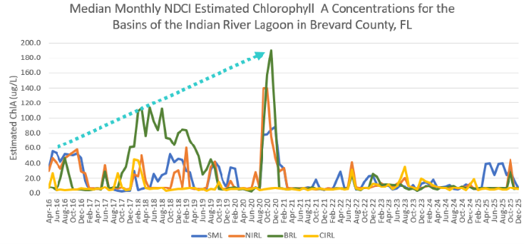
It is only considered a harmful algal bloom when it is at high bloom levels for more than a week. The concern is about it blocking too much sun from seagrass on the bottom or in the case of some species of algae. Luckily, our bloom levels have dropped drastically and leveled off over the region since 2021 (see the table below). Of course there are concentrated areas that will see spikes, but overall, the trend for algae blooms has been improving with fewer harmful blooms. As we continue to reduce nitrogen and phosphorus pollution levels in the lagoon, we should see this decreasing algae bloom trend continue, also.
There are many threats to the lagoon. 34% of the nitrogen pollution in the lagoon comes from muck flux, 40% from groundwater baseflow (septic, leaking sewer, reclaimed water, fertilizer, and pet waste), 11% from stormwater runoff (fertilizer, grass clippings, yard waste, and road grime), 15% from atmospheric deposition (car and industrial exhaust), and 1% from point sources (sewage spills and releases). We must address all the various sources of pollution to get to a healthier lagoon.
MULTI-FACETED APPROACH
In order to achieve a healthy Indian River Lagoon, we must take a multifaceted approach which includes reducing nutrient inputs, removing legacy loads of nutrients, restoring natural shorelines and filter feeders, and responding to new research, technology and opportunities to improve the Indian River Lagoon. We have been adding excess nutrients to the Indian River Lagoon for over 50 years. It will take time to remove that legacy load of pollution and reduce additional inputs before we see the impact of our current restoration efforts. The Save Our Indian River Lagoon Plan is just one component to restore our estuary. You can do your part by adopting a Lagoon friendly lifestyle. Read monthly Progress Reports on the Save Our Indian River Lagoon Program website www.brevardfl.gov/SaveOurLagoon or posted to our Facebook.
Muck covers the natural sandy bottom, destroys habitats such as seagrasses by inhibiting growth, and impacts bottom-dwelling organisms by depleting oxygen in the sediments and surroundings waters. Muck also contains nitrogen and phosphorus, which it continuously releases into the water, thus feeding algal blooms. Muck is the largest single contributor of nutrients to the Indian River Lagoon leaching over 650,000 pounds of nitrogen and over 60,000 pounds of phosphorus annually. It makes up 34% of the nitrogen and 26% of the phosphorus loading to the Lagoon.
Oysters are a natural filter for the water in the Indian River Lagoon. They eat planktonic algae, like that seen in algal blooms, and can filter 25-30 gallons of water per day. Unlike clams, they will still feed during heavy algal blooms. They also help reduce nitrogen in several ways. They can incorporate nitrogen into their shells and tissues. Additionally, they promote growth of beneficial bacteria on their shells and in their guts that are part of the denitrification process. The reef itself provides a three-dimensional structure that provides habitat for many organisms. It also creates a wave break that diminishes the amount of erosion along the shoreline, which reduces one of the components of muck.
Monitoring of the Geiger Point oyster reef not only showed a 98.5% survival rate of the oysters placed on the reef after six months but also substantial growth of the restoration oysters and recruitment of wild oysters. This was in the middle of three months of intense brown tide in the area. In the right locations oysters can be successful and provide many benefits to the health of the Indian River Lagoon.
You can get involved with oyster restoration through material prep or reef building events. If you live along the Lagoon you can also become an oyster gardener to help grow the oysters used for reef creation. Those not on the lagoon can fill in for gardeners when they are away. Get more information and sign up for an event at RestoreOurShores.org.
The State issues permits to some industries to discharge certain types of water, like water from cooling systems, into the lagoon. Freshwater can be considered a pollution source in itself and the water may also contain other pollutants. While this is a source of potential algae-feeding pollution, it is one of many and equates to only 1% off the nitrogen pollution in the lagoon. This doesn’t mean we shouldn’t reduce these sources too, as even smaller pollution reductions can add up to benefits to lagoon restoration. Some of these agencies have added water treatment on site before discharging the water and the County encourages others to follow this example. Meanwhile, SOIRL will continue to implement pollution reduction projects for the many larger pollution sources we can control.
HAVE A QUESTION?
Get Connected with us.
Want to help? Join up.
ASK YOUR QUESTIONS HERE.