




Lagoon FAQs
Many organizations and entities are working to improve the health of our Lagoon.
Begin to get acquainted to what impacts the Indian River Lagoon.
Learn about the plans and projects already underway. It's a complex issue- one that is critical to all of us and future generations.
Here are common questions and answers - a good place to start, provided by the Save Our Indian River Lagoon Program team.
2026
While the media may portray sewage spills as one of the largest sources of lagoon pollution, reality is that they actually are one of the smallest, contributing only 1% of the pollution. We still want to work to reduce them, as they cause immediate localized impacts. But we also need to simultaneously address a much larger invisible sewage pollution source from septic systems. Septic systems help remove bacteria and virus but do a poor job of removing algae feeding nutrients like nitrogen. Only 10%-40% of the nitrogen is removed from septic sewage before it reaches the groundwater and eventually the lagoon. The 62,000+ septic systems in Brevard add the equivalent of a 3.7-million-gallon sewage spill to the lagoon every day. That is over 1.3 billion gallons of septic sewage pollution entering the lagoon every year. Using the average sewage spills from the treatment plants, it would take over 150 years of sewer plant spills to equal just one year of septic tank pollution in the lagoon. This is why it is important we also address septic and other forms of lagoon pollution, while also addressing the sewage treatment plants.
The 3 million gallons of sewage spilled in Palm Bay in 2025 is what the septic systems release into the lagoon daily. While we want to do what we can to reduce sewage spills that produce immediate impacts, we also need to prioritize removing septic tanks which are constantly releasing sewage pollution into our groundwater and lagoon.
All traditional septic systems in the lagoon watershed must either connect to sewer, if available, or upgrade to an advanced septic system by 2030. If are wondering if your current system is eligible for grant funding to upgrade to an advanced system, go to https://www.brevardfl.gov/SaveOurLagoon/maps. Find link for the Save Our Indian River Lagoon Septic Mapper–shows how much you are eligible to receive for a septic upgrade or if your home will be converted to sewer in the future. All homes receive a minimum of $6,000 even if the mapper shows a lower eligible amount. If you are still uncertain you can email IRLProject@brevardfl.gov with any questions.
On the Maps tab of our website https://www.brevardfl.gov/SaveOurLagoon/maps, see link for Save Our Indian River Lagoon Septic Mapper. The colored outlines on the map are areas that are planned to be connected to the sewer system. You may also email IRLProject@brevardfl.gov with any questions.
Muck is known to release nutrients into the water column, often referred to as muck flux. It is the largest single contributor or nitrogen (34%) and phosphorus (26%) to the Indian River Lagoon leaching over 1.2 million pounds of nitrogen and nearly 85,000 pounds of phosphorus annually. The water in canals is part of the larger Indian River Lagoon system and nutrients can move out of canals into the main portions of the Indian River Lagoon.
We tested 240 muck samples from various sites to locate the hot spots that would provide the most nutrient removal when we were planning our muck sites. There were 100 sites in the open lagoon and 140 in canals. It was determined that the muck flux in the canals was 37% higher for nitrogen and 90% higher for phosphorus. Through testing all of these sites, we were able to determine that the 6,000 acres of muck in Brevard fluxes over 1.2 million pounds of nitrogen every year.
Muck is fine-grained organic rich sediment with high water content. It is made up primarily of clay, sand and organic matter (decaying plant material). Muck is tested for toxicity and if it contains unacceptable levels of toxins it is disposed of at the landfill. So far the muck we have removed has passed toxicity tests and can be used for other purposes like construction fill and agricultural fertilizer.
It is estimated that dogs and cats in Brevard County produce about 24 million lbs. of waste per year. National studies have shown around 40% of people do not pick up their pet waste. So, that means 9.6 million pounds of pet waste containing 144,000 pounds of nitrogen is left on the ground per year. While not all of that may make its way to the lagoon it still contributes pollution to the lagoon. So Yes the little things we do at home and in our neighborhoods can help.
Before the 1990s most stormwater drainage was designed to prevent flooding by moving water quickly away from our homes and businesses. Much of that was directed into canals emptying into the Lagoon. These canals also carry stormwater pollution to the Lagoon. This water can be a problem not only because of the excess nutrients from fertilizer, grass clippings and other yard debris, pet waste, trash, and road grime it picks up, but also the excess freshwater in itself can be a pollutant in the Lagoon if there is too much of it at once.
The flow of this water can be slowed through retention projects like ponds, ditches, and swales that hold the water longer, allowing it to filter into the ground instead of rushing into the lagoon.
One other way SOIRL is working to reduce freshwater is through canal re-diversion. The completed C-1 and M-1 canal re-diversion projects move water in Palm Bay and Melbourne/West Melbourne away from the Lagoon and send it into treatment areas and filter marshes along the St Johns River. The C-10 Water Management Area project is underway and will divert additional water from Palm Bay, back to the St Johns, where it would have naturally flowed.
Muck is first placed in a Dredge Material Management Area (DMMA) in order to dry. The material is tested for toxicity. If it is deemed toxic it must be disposed of in the landfill. If it passes toxicity tests it can be used for various purposes. The heavier sediments of sand and clay can be used for fill on construction sites. The finer sediments with higher organic content can be used for fertilizer application in agriculture areas like sod farms. Previous projects moved the muck to such areas west of I-95 outside of the Indian River Lagoon watershed. Some DMMA sites are designed for permanent storage of material.
The other counties are funding restoration projects through other methods, such as property taxes or special assessments.
Longer daylight hours, warmer water temperatures, and frequent rain flushing excess nutrient pollution from the land. Likewise, they can crash rapidly from several days of rainy cloud cover or if the bloom uses up all of its nutrient food source in the area.
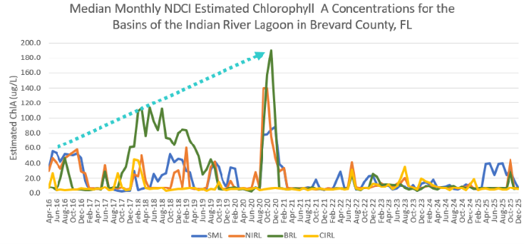
It is only considered a harmful algal bloom when it is at high bloom levels for more than a week. The concern is about it blocking too much sun from seagrass on the bottom or in the case of some species of algae. Luckily, our bloom levels have dropped drastically and leveled off over the region since 2021 (see the table below). Of course there are concentrated areas that will see spikes, but overall, the trend for algae blooms has been improving with fewer harmful blooms. As we continue to reduce nitrogen and phosphorus pollution levels in the lagoon, we should see this decreasing algae bloom trend continue, also.
There are many threats to the lagoon. 34% of the nitrogen pollution in the lagoon comes from muck flux, 40% from groundwater baseflow (septic, leaking sewer, reclaimed water, fertilizer, and pet waste), 11% from stormwater runoff (fertilizer, grass clippings, yard waste, and road grime), 15% from atmospheric deposition (car and industrial exhaust), and 1% from point sources (sewage spills and releases). We must address all the various sources of pollution to get to a healthier lagoon.
MULTI-FACETED APPROACH
In order to achieve a healthy Indian River Lagoon, we must take a multifaceted approach which includes reducing nutrient inputs, removing legacy loads of nutrients, restoring natural shorelines and filter feeders, and responding to new research, technology and opportunities to improve the Indian River Lagoon. We have been adding excess nutrients to the Indian River Lagoon for over 50 years. It will take time to remove that legacy load of pollution and reduce additional inputs before we see the impact of our current restoration efforts. The Save Our Indian River Lagoon Plan is just one component to restore our estuary. You can do your part by adopting a Lagoon friendly lifestyle. Read monthly Progress Reports on the Save Our Indian River Lagoon Program website www.brevardfl.gov/SaveOurLagoon or posted to our Facebook.
Muck covers the natural sandy bottom, destroys habitats such as seagrasses by inhibiting growth, and impacts bottom-dwelling organisms by depleting oxygen in the sediments and surroundings waters. Muck also contains nitrogen and phosphorus, which it continuously releases into the water, thus feeding algal blooms. Muck is the largest single contributor of nutrients to the Indian River Lagoon leaching over 650,000 pounds of nitrogen and over 60,000 pounds of phosphorus annually. It makes up 34% of the nitrogen and 26% of the phosphorus loading to the Lagoon.
Oysters are a natural filter for the water in the Indian River Lagoon. They eat planktonic algae, like that seen in algal blooms, and can filter 25-30 gallons of water per day. Unlike clams, they will still feed during heavy algal blooms. They also help reduce nitrogen in several ways. They can incorporate nitrogen into their shells and tissues. Additionally, they promote growth of beneficial bacteria on their shells and in their guts that are part of the denitrification process. The reef itself provides a three-dimensional structure that provides habitat for many organisms. It also creates a wave break that diminishes the amount of erosion along the shoreline, which reduces one of the components of muck.
Monitoring of the Geiger Point oyster reef not only showed a 98.5% survival rate of the oysters placed on the reef after six months but also substantial growth of the restoration oysters and recruitment of wild oysters. This was in the middle of three months of intense brown tide in the area. In the right locations oysters can be successful and provide many benefits to the health of the Indian River Lagoon.
You can get involved with oyster restoration through material prep or reef building events. If you live along the Lagoon you can also become an oyster gardener to help grow the oysters used for reef creation. Those not on the lagoon can fill in for gardeners when they are away. Get more information and sign up for an event at RestoreOurShores.org.
The State issues permits to some industries to discharge certain types of water, like water from cooling systems, into the lagoon. Freshwater can be considered a pollution source in itself and the water may also contain other pollutants. While this is a source of potential algae-feeding pollution, it is one of many and equates to only 1% off the nitrogen pollution in the lagoon. This doesn’t mean we shouldn’t reduce these sources too, as even smaller pollution reductions can add up to benefits to lagoon restoration. Some of these agencies have added water treatment on site before discharging the water and the County encourages others to follow this example. Meanwhile, SOIRL will continue to implement pollution reduction projects for the many larger pollution sources we can control.
LEARN MORE
The IRL is in five Florida counties. Learn more about the IRLNEP One Lagoon plan.
71% of the IRL is in Brevard County. Progress is being made to restore the Lagoon through the Save Our Indian River Lagoon Program. Stay up to date on projects and progress here.
A long list of partners are part of the effort. Meet many of them on the pages of the HelpTheLagoon.org website.
Connect with us whenever you have a question or a way you might be able to help.