



May 22, 2026 – By Sally Scalera (originally appeared in FLORIDA TODAY)
Sally Scalera is an urban horticulture agent and master gardener coordinator for the University of Florida’s Institute of Food and Agriculture Science.
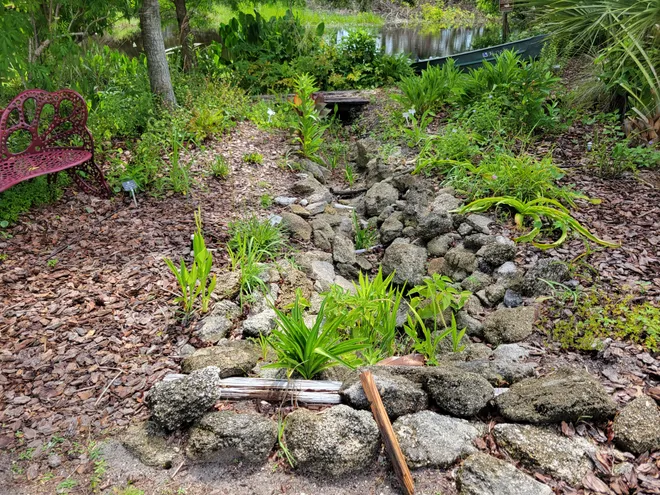
The eighth Florida-Friendly Landscaping™ principle, reducing (or better yet, preventing) stormwater runoff, will keep non-point source pollution out of our waterways. Stormwater can carry pollutants such as nitrogen, phosphorus, grass clippings, pet waste, soil particles, and oil to the nearest water body.
But there are ways to keep rainfall on your property!
Here in Brevard County, every yard is in one of four river basins, which include the St. Johns River, Indian River, Banana River, and Mosquito Lagoon. Though it is easy to understand how a waterfront home could impact the waterbody it borders, that is also true for a yard five blocks away, a mile, or even on the edge of the watershed’s boundary. When nutrients leach through the soil, they end up in groundwater and are carried to the water body, regardless of the distance.
Take Suntree, for example, where all the wet retention ponds, often called lakes, are plumbed together so that the water flows from one to another, eventually flowing into the Indian River Lagoon (IRL). The ponds do a good job capturing sediment, but excess nutrients will remain in the water (unless littoral plants are planted around the pond or floating plant mats are used) and carried to the IRL. Therefore, how you care for your landscape also affects the watershed’s health.
So, check out these suggestions and see if they could stop stormwater runoff from flowing off and/or leaching from your property!

A Florida-friendly yard is at its best when it can hold all the rainfall that falls on the roof, yard, and impervious surfaces, allowing it to soak into the soil. Yards with soils containing healthy amounts of organic matter (at least 5%, which is not typical in most yards) absorb rainfall and irrigation like a sponge, storing it for plants to use later. This one goal, increasing soil organic matter, accomplishes the following three goals: preventing stormwater runoff, the leaching of nutrients, and the movement of water through the soil and into the groundwater.
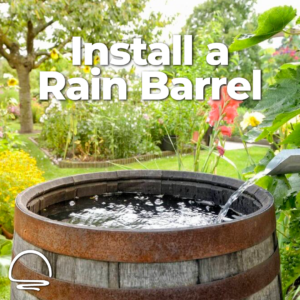 Handling rainwater and runoff with gutters
Collect rainfall from your roof with either rain barrels or a cistern, which can hold hundreds or thousands of gallons of water. Gutters make it easy to collect the maximum amount of rainwater, but even placing a rain barrel where two roof lines meet or under an eave can collect an amazing amount of water in a storm. Multiple rain barrels can be connected if needed, and mosquitoes will not be a problem when constructed correctly. The collected water can be used to water ornamental plants and to wash tools, etc.
At a minimum, install gutters along roof areas that hang over impervious surfaces like driveways, entrances into the home, patios, pool decks, etc. Rainwater that falls onto impervious surfaces can increase runoff, which can carry heavy particles and cause soil erosion. If you have downspouts that don’t empty into a rain barrel or cistern, aim them towards pervious surfaces. The best option would be to distribute the water over the lawn or landscape by adding an extension to the downspout.
Reduce or eliminate impervious surfaces using pavers, gravel, mulch, turf block, bricks, pervious cement, etc. If you are repairing your driveway or adding a new patio area to the yard, consider porous surfaces that will allow rainfall to seep into the ground.
Create berms or swales near the edge of your property to catch all the rain and hold it until it is absorbed by the soil. For waterfront yards, a berm and swale combination, constructed above the high waterline and parallel to the shoreline, will keep stormwater runoff from flowing directly into the water.
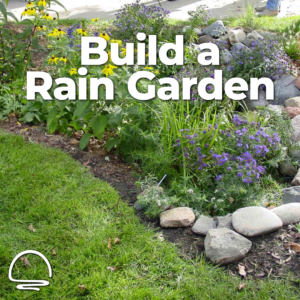 If you have an area that collects water after heavy rain, consider creating a rain garden. A rain garden is essentially a swale designed to collect water during a heavy rainstorm. Plants are grown in the swale to add beauty year-round, even when not holding excess water. For more information on rain gardens, check out this website: https://gardeningsolutions.ifas.ufl.edu/design/types-of-gardens/rain-gardens/.
Incorporating as many of these ideas as possible in your landscape could eliminate stormwater runoff. Your yard will benefit from the water captured in rain barrels or cisterns, as well as from the soil. The more yards that eliminate stormwater runoff, the better off our waterways will be. If some of these suggestions sound good for your yard, add a new project or two to your list!
What You Can Do Today:
Support the Brevard Indian River Lagoon Coalition.
Explore MEMBERSHIP and benefits. Or make a DONATION.
Be part of the solution.
Right now there are vital VOLUNTEER OPPORTUNITIES available.
SIGN UP today for talking to your neighbors, linking us to groups and organizations where we can speak, pointing us to events and other opportunities to provide educational materials, and how to share LAGOON Education social posts with people you know.